Sleep Education · Fort Lauderdale
Reading Organic Mattress Certifications: What the Labels Mean
A mattress may be made from cotton, wool, latex, foam, steel, and a collection of carefully worded promises. Its labels can tell you something useful about those materials—but only if you know what, exactly, has been certified. The crucial distinction is often between a certified ingredient and a certified finished product.
There is a particular kind of confidence conveyed by the word organic. It suggests a material with a past: a field, perhaps, or a stand of rubber trees; an account of how something was grown, processed, and carried through the world. On a mattress tag, however, the word may be doing more modest work. It might refer to the cotton in the cover, the latex in a layer, or one component among several. A mattress assembled from those components does not automatically inherit every claim made about each one.
This is not necessarily a trick. Mattresses are complex objects, and certifications are generally designed to assess particular materials, processes, or products under defined standards. A certificate for organic cotton does not certify the latex beside it. A certificate for latex does not establish that every part of the finished mattress is organic. And a mark associated with chemical testing or environmental management may be meaningful without being an organic certification at all.
For shoppers comparing organic mattresses, the useful habit is to read labels as carefully as one might read a map: identify what the symbol covers, what it leaves out, and who is responsible for verifying the claim. In Fort Lauderdale and across South Florida, where warm nights and humidity can make comfort and breathability feel unusually immediate, material choices may matter a great deal. Certification, though, is a separate question from whether a mattress will feel comfortable in your room.
First, ask what the certification applies to
A mattress is not a single material. It may contain a core, comfort layers, upholstery, a fabric cover, thread, adhesives, a fire barrier, and other components. A certification can apply to one of those ingredients, a particular textile, a manufacturing facility, or a finished article. Those are different claims, even when a product page places them close together.
Imagine a mattress built with certified organic cotton fabric, certified organic latex, wool, and several other materials. The cotton and latex may each have documentation describing their own status. That does not by itself show that every component in the mattress is certified, that the entire product has been assessed under one standard, or that every step in its supply chain has been verified. The distinction is easy to miss in a short product description, where “organic materials” can sound like “an organic mattress.”
When you encounter a label or claim, look for its grammatical subject. Is it “the cotton,” “the latex,” “the cover,” “the facility,” or “the mattress”? If the wording does not make that clear, ask for clarification. A useful answer names the standard, identifies the exact material or product covered, and points to documentation that supports the claim.
Certification is also not a synonym for quality, comfort, durability, or suitability for a particular sleeper. Those may be important buying questions, but they require different evidence. A certified material can still feel too firm, too soft, or too warm for someone’s preferences. Conversely, a mattress can be comfortable without every component carrying an organic certification.
GOTS: a standard for organic textiles
The Global Organic Textile Standard, usually shortened to GOTS, is a widely recognized certification for textiles made with organic fibers. It addresses more than the origin of a fiber. Depending on the product and the applicable version of the standard, its requirements cover aspects of processing, environmental management, and social criteria across the textile supply chain.
For a mattress, GOTS may be relevant to fabric or other textile components made from organic fibers, such as cotton. But the presence of GOTS-certified cotton does not, on its own, certify a mattress’s latex core, metal springs, or every other part of its construction. Nor does a GOTS mark on a supplier’s fabric establish that the finished mattress itself is GOTS certified. The scope matters.
Two phrases shoppers may see are “organic” and “made with organic.” Under GOTS, product labeling depends on the share of organic fibers and other conditions defined by the standard. Rather than trying to infer those details from a large headline, check the full claim and the product’s certification documentation. The standard’s own labeling rules and public resources are the best place to confirm current requirements, since standards can change over time.
It is worth noting that certification of a textile says something about the textile within the certification’s scope. It is not a general guarantee that a product will be free of every substance a particular person might react to, or that it will resolve a health concern. Certifications have boundaries; responsible interpretation respects them.
GOLS: a standard for organic latex
The Global Organic Latex Standard, or GOLS, is associated with organic latex products and their supply chain. It can address the organic status of the natural rubber raw material as well as specified processing and chain-of-custody requirements. When a mattress includes latex described as GOLS certified, the important question is whether that certification covers the latex component in the product being considered—and whether the claim can be documented.
Natural latex and organic latex are not interchangeable terms. “Natural” describes a material’s origin or composition in broad terms; it does not, by itself, prove that the rubber was produced under an organic standard. Likewise, a product made with latex is not necessarily made entirely from latex, and a certified latex layer does not certify the mattress cover or other materials.
Latex processing methods, such as Dunlop and Talalay, describe ways of producing latex foam. They are not organic certifications. A mattress can use either type of latex and still require separate evidence for any organic claim. It can also combine different layers or materials, so a product listing should say which layers are certified and how they are identified.
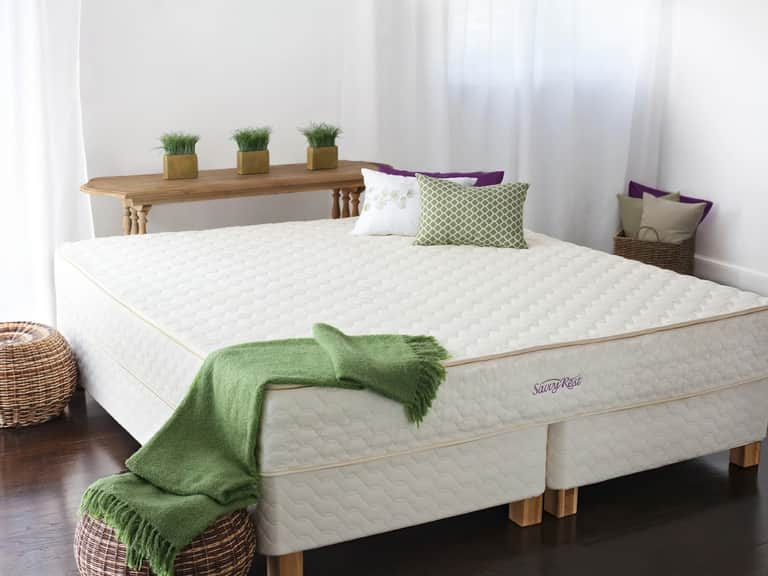
One example of why this level of detail helps is the Savvy Rest Serenity Latex Mattress. Its product information describes a customizable mattress with latex layers, an organic cotton casing, and organic wool quilting, and identifies the latex as certified organic. For a particular configuration or purchase, a reader should still confirm which materials and layers are covered by current certificates and how those certificates relate to the finished construction. The example is useful not as a shortcut around documentation, but as a reminder that a mattress can contain several materials whose claims need to be considered separately.
USDA organic: understand the context
The U.S. Department of Agriculture administers the National Organic Program, which regulates organic agricultural production and labeling in the United States. Its familiar seal is principally associated with qualifying agricultural products and processed foods. In bedding discussions, shoppers may see USDA organic language connected to agricultural raw materials or to a supplier’s certification. That wording should not be read as proof that an entire mattress has been certified as an organic product under a single, mattress-wide USDA category.
For a claim involving cotton, wool, or natural rubber, ask what organization certified the agricultural material, which standard was used, and how the material’s identity was maintained as it moved through processing. A company may describe an agricultural source as certified organic while relying on a separate textile or latex standard to assess the processed component. That can be legitimate; it simply means the certificates do different jobs.
Be alert to loose phrasing such as “USDA-approved mattress” or “USDA organic mattress” when no clear explanation follows. A credible claim should identify the applicable program and the precise material or process it covers. When in doubt, consult the certifier or the relevant official program rather than relying on a logo reproduced in an advertisement.
Other labels can be useful without meaning “organic”
Mattress descriptions may also include marks related to emissions, chemical testing, responsible forestry, or general environmental management. Such labels can answer worthwhile questions, but they should not be mistaken for organic certification.
- Emissions and chemical testing: A certification may assess a product or material against limits for particular substances or emissions. Read its scope and testing criteria. It does not automatically certify organic farming or the origin of every ingredient.
- Responsible forestry: A forest-related certification can provide information about sourcing for materials such as wood or paper. It does not establish that cotton or latex is organic.
- Facility or management standards: A manufacturer or processing site may be assessed for environmental or quality-management practices. That is not the same as certification of the mattress’s ingredients.
- “Natural” or “eco-friendly” language: These terms can express a general product description, but without a named, verifiable standard they do not tell you exactly what was measured or certified.
None of this makes one kind of certification more important than another in every situation. It means they should be read for what they actually establish. Someone concerned about the origin of latex may prioritize a latex-specific standard; someone comparing textile sourcing may focus on a textile standard; someone interested in emissions may look for a relevant emissions program. One symbol rarely answers every question.
A practical way to examine a mattress claim
Certification language need not turn a bedroom purchase into an audit. A short, repeatable checklist can bring order to the small print.
- Name the certifier and standard. Look for a specific organization and a specific standard, not merely a leaf-shaped logo or the word “certified.”
- Identify the certified object. Is the certificate for a raw material, a processed component, a textile, a production facility, or the complete finished mattress?
- Match the paperwork to the product. Ask whether the certificate applies to the manufacturer, supplier, product line, or exact model. If the mattress has selectable layers or configurations, ask whether those options change the documented materials.
- Check dates and validity. Certifications may be renewed, amended, suspended, or tied to a particular period. Current documentation is more informative than an old certificate displayed without context.
- Follow the chain of custody. For a material claim, find out whether the documentation traces the material from its certified source through the relevant processing and into the product.
- Separate material claims from performance claims. Organic status does not tell you whether the mattress is the right firmness, has the right support, or will last for a particular number of years.
- Ask for a plain-language explanation. A seller should be able to tell you which part is certified and provide a meaningful reference to the underlying documentation.
These questions are especially helpful when a description makes a broad claim in its headline and a narrower one in the specifications. A page might say “organic mattress” at the top, then clarify that the cover is made from certified organic cotton and the latex is certified separately. That distinction does not make the product inferior. It makes the precise wording important.
Why construction still deserves a close look
Certifications illuminate the origins or treatment of materials. They do not replace a construction diagram. To understand a mattress, ask what is inside it, how the layers are arranged, whether the cover can be removed, and which parts can be maintained or replaced. The answers may be relevant to comfort and longevity regardless of certification status.
A layered latex mattress, for example, is not a single undifferentiated block. Its feel depends on the number, thickness, and firmness of the layers, along with the cover and any wool or other upholstery. If a model is customizable, the configuration selected may affect the final material list. Keep a copy of the specifications for the exact version you are considering; a general product description may not capture every possible combination.
Climate belongs in this conversation, too, though it is not a certification question. In Fort Lauderdale, a warm, humid bedroom can influence how a person experiences bedding. Breathable covers and moisture management may matter to comfort, and a well-ventilated bed base can help air circulate around the mattress. But a “breathable” or “temperature-regulating” claim is not proof of organic status. Nor can any particular material guarantee a cool night in every room: bedding, airflow, indoor temperature, and individual preference all contribute.
Care instructions are another part of the record. A mattress cover may be spot-clean only, while a separate pad may be washable. A certification does not make materials impervious to spills or remove the need to follow manufacturer guidance. Before buying, it is sensible to know how the product should be protected, cleaned, and supported.
Common misunderstandings, gently corrected
“Organic” means the whole mattress is organic. Not necessarily. The term may refer to a specified ingredient or component. Look for a clear statement of scope.
“Natural” means certified organic. It does not. Natural describes a source or material in a broad way; organic status requires evidence under a defined standard.
One certificate covers every material in the bed. Usually, different materials and processes call for different evidence. A textile certificate and a latex certificate may complement one another without becoming one mattress-wide certification.
A certification proves a mattress is safe for everyone. No label should be treated as a universal medical guarantee. Standards have specific criteria and boundaries; personal sensitivities and health questions may require advice from a qualified professional.
A product without an organic label is automatically poor quality. Certification is one way to evaluate sourcing and processing, not a complete measure of comfort, workmanship, durability, or value. Decide which evidence matters most to you, then compare products on those terms.
A logo is the same thing as verification. A graphic can be reproduced in many places. The useful evidence is the standard, scope, certificate holder, and current documentation behind it.
A quieter, clearer kind of comparison
The marketplace often presents the organic mattress as a single idea, cleanly packaged and ready to be chosen. The reality is more particular. One mattress may contain certified organic latex and cotton; another may use a certified textile but a different core; a third may emphasize emissions testing or another kind of material disclosure. Those differences are not always visible in a headline, and they do not resolve every question about how a mattress will feel.
Start with the materials you care about. Then find the standard that applies to each one. Confirm whether the certificate concerns the ingredient, the processed component, or the finished product, and ask for documentation that matches the model and configuration in front of you. Finally, consider the less ceremonial matters: support, firmness, care, dimensions, ventilation, warranty terms, and the realities of your bedroom.
A certification label is not a verdict. It is a piece of evidence with a defined jurisdiction. Read it closely, ask what it covers, and let it inform—not replace—your judgment. The result is a more honest comparison: less enchanted by the word “organic,” and better equipped to understand what the mattress actually contains.